Failure is not do or don’t do, it’s a feeling of deep knowledge that you will not return to try again. It’s a moral injury. In the case of my attempt at badassery, it was a literal injury.
Read More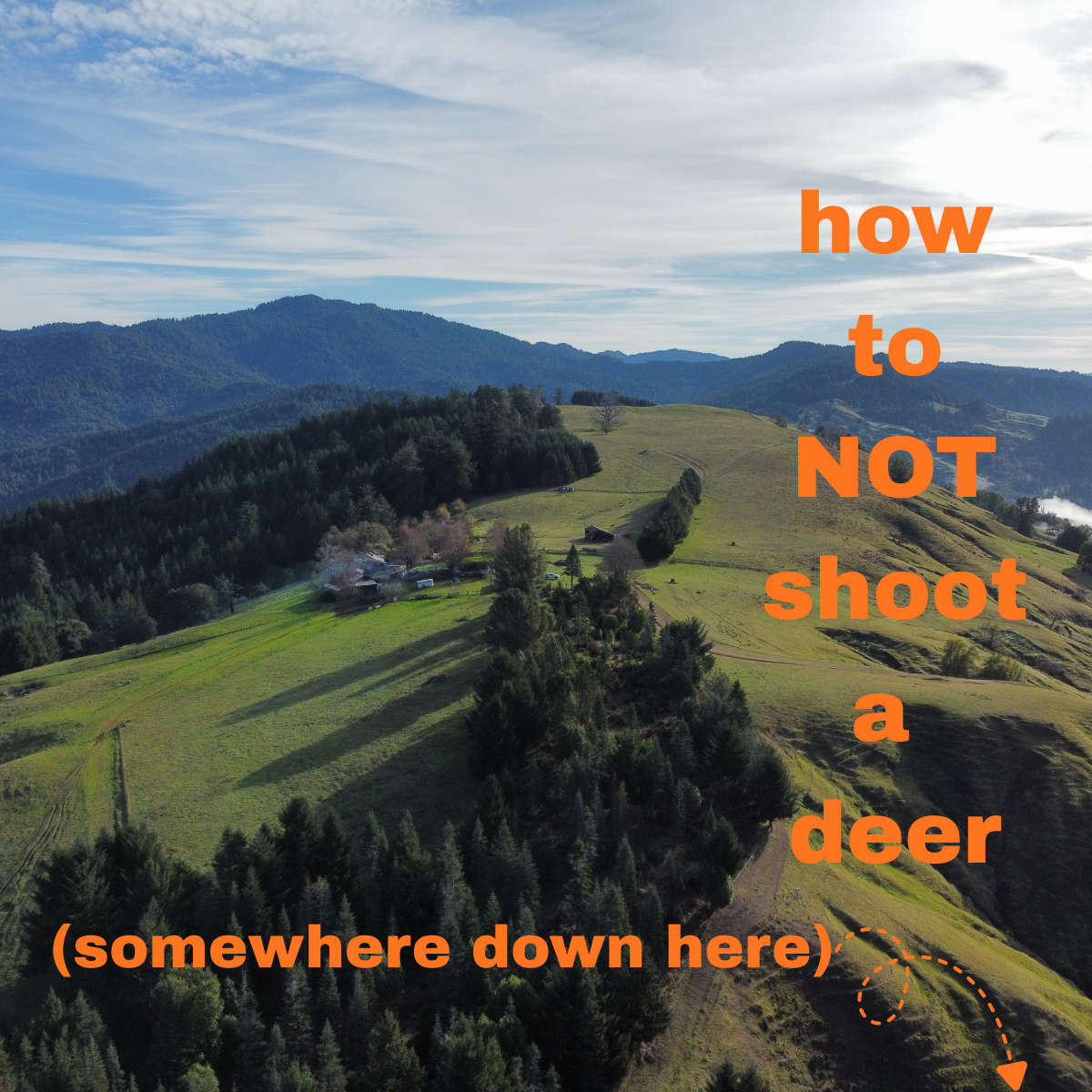
How to Not Shoot a Deer
Rifle season just opened in Southern Humboldt, where my family lives. It’s a busy time of year with its own set of rituals, including taking advantage of our seasonal visitors by putting them to work helping mark calves. I was up until 11:30 last night skinning a buck, then up again at 5 because the dogs were sure something was creeping and crawling around the barnyard. Today I let the mama cows chase me around because we all need more exercise, and let Dad process my buck into smaller pieces because he’s better at it than I am. I’m tired. I’m sore. I got home at 3 p.m. with an aching back and blood caked under my fingernails, smelling like a combination of an abattoir and wet leather. The thing is, I’m usually so good at NOT getting a buck during hunting season. What happened? If you’re hoping to avoid a scenario which involves blood, ticks and figuring out 90 new recipes for venison, I have some tips for you.
1. Go alone. I’ve never had a successful hunt when going out alone. Unfortunately, last night I had my experienced older cousin and family friend with me, who I’m not going to name because he didn’t consent to being written about. Also, I’m worried that he’s going to be bombarded with requests from other people because he is really good at spotting deer and for whatever reason loves to take people hunting.
2. Take a dog. The Old Dog was not invited on this hunt, for reasons that should be clear to anyone who’s met him.
3. Try to look cool. In the steep ridgelands where I’m from, a successful hunt often depends on one’s ability to do the “creep and peep,” which means hunching down so a deer won’t see your head pop up over the horizon, waddling from a squat position to almost the top of the ridge then army crawling so you can ‘peep’ down at the treeline. If you don’t want to get a deer, I suggest walking normally and not finding out how out of shape you are.
4. Don’t look down. As I said, much of the time you’re going to see deer near the treeline, often under the oaks that climb the grassy golden hills in the late summer. I cannot overstate how steep most of these hills are. In recent years I’ve noticed a strange phenomenon with our hunting camp friends. The older they get, the less their eyeballs seem to be able to look downhill to where the likely bucks might be, bedded down at the bottom of gullies full of poison oak. I might be struggling with the onset of whatever eyeball arthritis this is myself, because when we had crept and peeped our way to the lip of a rocky ledge, I told my cousin, “I am not shooting anything down there.” He seemed a little nonplussed, but we duly made our way across the ridgeline, where it was equally steep but at least not rocky. If you want to avoid shooting a deer, I recommend looking up for ones that will roll themselves into the back of your truck only.
5. Share your thoughts. As you might imagine, you’re supposed to be on the quiet side when you’re trying to sneak up on a fleet forest creature with ears like satellite dishes. Experienced hunters frown on their companions sharing the contents of their hearts and minds during a hunt. Good hunters find that their minds are delightfully blank at times like these, as they creep their way through the tall grass, trying not to make every single leaf and twig crackle under their boots. Hunting is very meditative, very awe-inspiring. It was about an hour before dusk and a half-moon had hung itself on the horizon. I was feeling very happy about the whole experience, spending time with my family, breathing in the clean air, knowing that soon it would be too late to hunt and we’d go back to the house where I could drink some cold water and release the Old Dog from confinement. I knew my cousin did not want to hear me talk about it, which is a shame, because I was filled with that same kind of sweet buzzing joy and contentment you sometimes get on a long distance run or a particularly good karaoke night. Thinking, “I could do this forever. God I love this. I hope I get to do this every weekend for the rest of the season.” But then he spotted a buck, which was the beginning of the end.
6. Be prepared. I’ve heard that fortune both favors the bold, and the prepared, which leads me to believe nobody actually knows what fortune, aka luck, favors at all. What I will tell you is that hunting generally favors Murphy’s law, and therefore the less prepared you are the more likely you are to suffer the misfortune of shooting a deer. So I recommend bringing a sharp knife, more than one flashlight and some water. It’s a good idea to be hydrated when you’re not trying to gut out a deer at the bottom of a ridge in near dark. One of many the flashlights you should bring is a headlamp, because you want to be able to see the bottom of the ridge where you’re not going to be cursing at your dull knife around a tiny flashlight held between your teeth. Also I recommend staying in good physical shape throughout the year. Can you imagine army crawling to the edge of a rocky point to take aim at a perfectly nice buck, only to find out that holding yourself up to take a good shot requires core strength that you apparently do not have? I can!
So I managed to shoot a nice three by three, a fat fellow who was sitting with two others about halfway down the ridge. My very kind cousin helped me locate him and then went to get the side by side. I would add a few more tips about how having a vehicle with a winch will almost certainly guarantee not getting a deer, but I feel like I’m stealing the glory from my companion a little bit, who helped me stagger up the slippery grass in the dark with my kill, each of us holding an antler, huffing and puffing and occasionally falling down. The spit-covered flashlight died about halfway up the hill. My cousin also, with righteous but not disdainful impatience, did most of the skinning once we got back to the house, alongside my father. And I’m grateful. To him, to the deer that gave his young life to my bullet so I can bring meat to my family and my neighbors, and help me get through the oncoming winter. But most of all, I’m grateful that I only got one tag this year. Maybe I’ll still go out next weekend, not to hunt for myself, but to help out. I am really not that good at creeping, peeping, shooting or skinning, but I still feel I have a lot to offer by way of advice.
Getting Away from Getting Away from It All
I took off work on Wednesday and drove to the back of the ranch on our side by side, my senior dog riding shotgun and an embarrassing amount of supplies for an overnighter. (Two books, one magazine, one notebook.) Dad’s new pup decided to follow. She’s really less of a puppy than a lolloping adolescent of a dog, all long limbs and affection. I didn’t invite her, but she had a yen for adventure and I figured she’d be good for alerting me to critters. My plan was to set my mattress up on the west side of a meadow by an old barn where I could view as much of the horizon as possible. The Perseid meteor shower was predicted to peak at around 4 a.m.
I don’t want to give the impression that I’m the outdoorsy type per say, but I do camp solo a few times a year, and particularly enjoy camping in the open. It’s not restful but it’s weirdly comforting to wake up periodically at the sound of a mysterious rustle in the brush, identify it as a wandering deer or squirrel, then look up at the friendly stars and blink myself back to sleep.
I get into my sleeping bag at around 10 p.m. after trying and failing to identify some constellations. The old dog curls up next to me. He resents the puppy and did not enjoy sharing his kibble. I look again for Aquarius. A meteor streaks over a line of tall trees to the north of me. I smile. I sleep.
10:30 p.m. – The sound of an ATV and both dogs losing their minds. I jump up, grab my bear spray and shove my feet into my unlaced boots. It’s my little brother, who’s come to check on me. Our respective circadian rhythms have always been off beat. Also, he’s got a flat tire. I send him back to the cabin on my side-by-side to get the pump and sit back down in a chair. The pup, who I’ve had to restrain to keep her from going with him, finally settles in with a long sigh. A few more meteors pass.
11:30 p.m. – My brother returns after finding a bicycle pump. He pumps up the tire, but can’t fix the flat. So instead he replaces the tire. This is long past my bedtime and I am feeling grumpy. We talk about the Pup and how it’s probably good that she followed me, because the Old Dog can’t hear much these days. My brother asks if I have a gun. No, I have the bear spray, I tell him. Which will work fine for most critters if I point it in the right direction. Having grown up on a ranch, I can say with experience that you face less danger from mountain lions and bears — which are naturally shy when not habituated to humans — than you do angry mama cows. He capitulates and finally leaves, but not before I have to again restrain the disloyal puppy from following him. She makes her amends by plopping her head next to mine on the air mattress, looking at me with adoration. The Old Dog turns his back to us in disgust.
12:15 a.m. – I wake up to the sound of the puppy enthusiastically slorping at her belly. I push her away. I look up and see a meteor pass.
1:36 a.m. – I wake up to the sound of stealthy rustling, but not from the woods. It’s from the old barn, which is full of mice. Who are apparently making their way towards the box of food I’d stupidly left out. Both dogs snore, apparently unconcerned, as I hobble over in sock feet to safeguard the food. I get back into my bag with wet socks and stare at the sky, waiting for a streak of light, until I fall asleep.
1:45 a.m. – The world’s most persistent mosquito is fixated on the back of my left ear, where I apparently forgot to apply repellent. I burrow myself into my sleeping bag with a groan.
2:30 a.m. – The Pup alerts us to an animal intruder. I stick my head out of the sleeping bag to identify if it’s a threat requiring the bear spray and immediately realize my mistake. I had prepared for cougars and bears and coyotes: I did not think about skunks. Her job done, the puppy comes and lays her head adoringly next to mine. My wool cap, my pillow, the top of the sleeping bag, my headlamp. It all smells like skunk.
“Go. Away.” I tell the puppy. She nestles closer.
3:30 a.m. – I blearily look for meteors, seeing two or three before falling asleep again
When I wake up again it’s dawn. I’m ready to get away from getting away from it all.
How Not to Write a Novel, Part III: Make It Perfect
Thank you for your continued readership of my series on how to not write a novel. Whether you’re a bright young writer with your whole career ahead of you, or a frustrated old crank with several drafts in a desk drawer, I promise I can help you avoid ever finishing and publishing a novel. You can finds parts one and two of this series on my website, linked here.
I’ve written before about perfectionism and how it subverts my ability to finish things. I think it’s time to get down to some definitions, because in order to avoid becoming a novelist you must be determined to write the perfect novel. The perfect novel is not only well-written, it is also completely comprehensible to its audience. Its motivations are clear. It will wrap at the end like a good game of solitaire, each card of each suite tucking themselves neatly into order, leaving the reader with a satisfied feeling.
The perfect novel is not a genre novel. It should defy genres! Defy conventions! But still be easy to understand!
The perfect novel may require hard work, but not struggle. The writer will not spend three weeks carefully crafting a subplot about its main character’s stay in a creaky old apartment complex only to realize later that this was totally unnecessary, and weep as she cuts out these chapters and the four or five extra characters she created. No! The perfect novel will not require plotting. The writer will write and the plot will appear before her as she does so, the path lit just a little ways ahead of each step, not a hole in sight. The gun brandished at the beginning of the first act will go off with a bang in the third.
Moreover, the perfect novel will be so good, unmistakably good, that it will be picked up by a publisher within a few weeks of its second edit. (The edit only being necessary, of course, to catch a few stray commas or other minor punctuation errors.) How does the publisher hear about it? That’s a good question. Because surely the writer hasn’t spent years throwing other work out into the world, trying to get anyone to pay attention to her, or searching for an agent. The cynics among you might believe the writer has connections, but even if she does, so what? If it’s the perfect novel, who cares if there’s a little hypothetical cronyism going on here?
Because the perfect novel will not only be published in a blistering six months, it will also make the New York Times Best Seller List, be nominated and win any number of Big Name Awards, be translated into 50 languages, be optioned for film, be taught in college classes about The Perfect Novel, change the lives of everyone who ever reads it and stay in print for decades, nay centuries, nay for the entire remaining history of human literature, for as long as humans read, forever and ever, its objective and universally agreed-upon value as a work of art only growing with time. And before the last human with eyes to read or ears to hear shuffles off this mortal coil, they will make sure to put The Perfect Novel in a titanium box so anyone or anything who wants to know what the pinnacle of literary human achievement looks like they will be able to gaze upon it, weep with joy and rebuild the next civilization in Its image.
And who has time to accept Pulitzers and fly around the world doing script supervision? Yeesh, what a nightmare. There’s so much good TV right now! And if you still want to write a novel for some reason, but know it’s not going to be The Perfect Novel, what’s even the point? Give up now. You’re welcome.
Welcome back to my series on how to avoid becoming a novelist, a feat at which I’ve had some middling success.
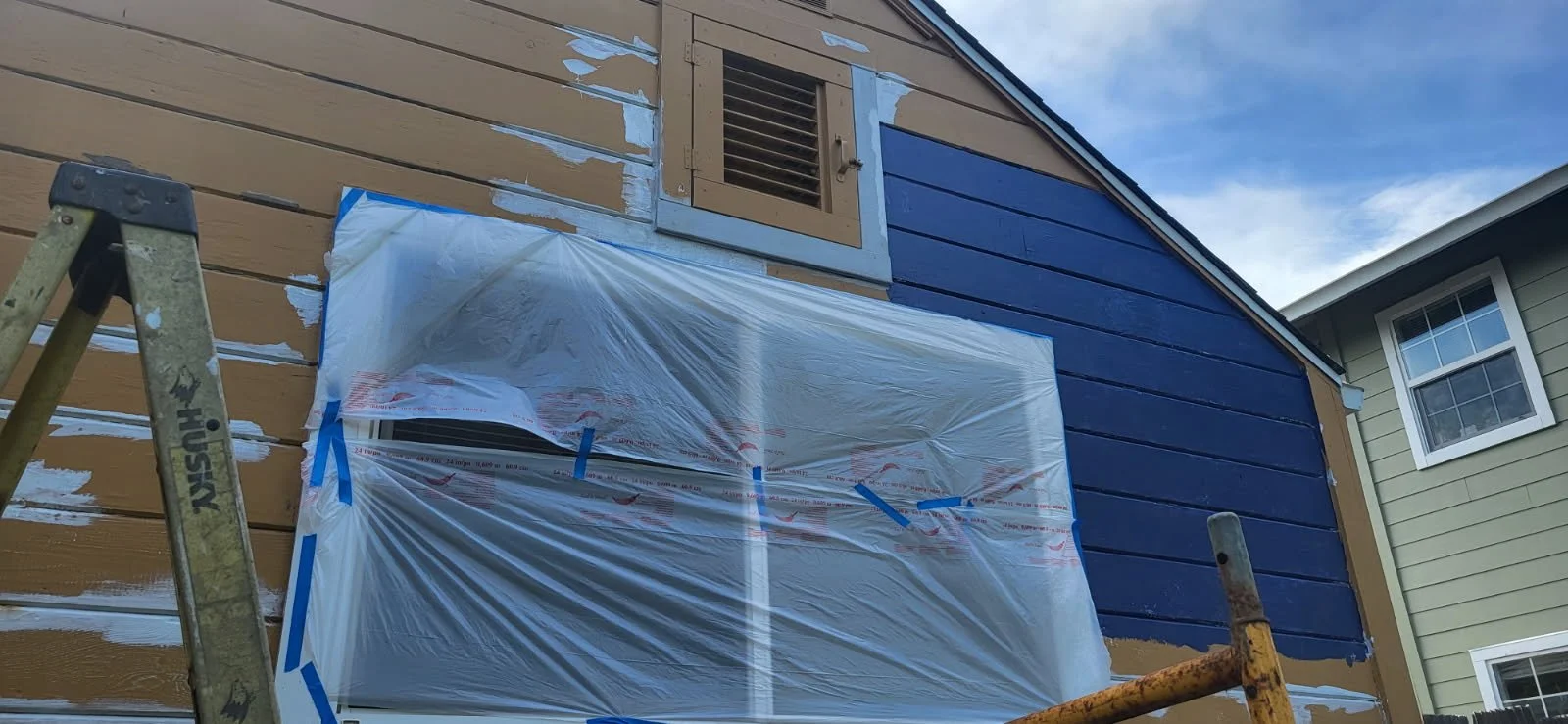
I am painting my house. I am doing it with a hand brush, not a roller or a sprayer. I am doing it stroke by stroke, layering dark blue over the original honey-mustard color. I am doing it without listening to a podcast, or music. I am doing it alone (for now). Today I stood on the scaffolding platform with a brush and a tray of dark blue promise. The name of the shade is Heirloom China. It was the perfect day for this job, the first weekend of August, about 70 degrees with a breeze.
Painting is good work for writing, because writing requires both large swathes of time in which to write, and large swathes of time in which to let your mind wander. I find characters and ideas come most easily to me when I’m walking my dog or doing manual labor, doing one task alone and undistracted.
This is not easy, for any number of reasons. Most of them have to do with money and loneliness. I promised in my last installment I would tell you about my failures, how despite knowing better I have written a few novels. Here’s what it took.
First novel (began 2010, finished 2012): Mystery novel set in Trinidad, CA. I sent it in installments to my grandmother, whom I was terrified of disappointing. I finished it the summer I quit my first grownup job. Gram said she had read worse novels, but also better novels, and that there was too much profanity in it. Thanks Gram.
Second novel (began 2012, finished 2016): Horror/mystery/thriller set in Eureka, CA. Wrote it for my my mom, who loved horror. It was a real start-and-stop process, but I finally finished after working straight through several Saturday nights in a row. The horror aspect of it never really gelled, and it’s still basically in pieces in my hard drive like an old car that’s been stripped for parts. My mom seemed to like it okay though.
Third novel (began 2019, finished 2021): My first non-genre novel, set in a fictional and unnamed East Coast town. It was the novel I quit my job to finish, in early 2020. Was not counting on an absolute shit tornado of both personal and geopolitical events to coalesce around the same time I made this move. I finished the edits while sitting vigil at my mom’s hospital bed shortly before her death from lung cancer. Cursed object, I don’t think I can go back to it.
You don’t need to be smart or funny or creative to write a novel. You need time and focus and the ability to say no. For me, the minimum amount of time I would like to spend writing every day is about two hours, and that’s not counting the lead up of dog walking or house painting I need to get myself ‘in the zone.’ Which makes money the issue, because um I need it to pay for this house I’m painting. And I’m expected to work to earn it, and novels are not real money makers until they are, and that takes a long long while, if not forever. (Column for a different day.) So I have to make choices.
I love so many things, and the capacity to love so many things is both a privilege and a burden. Because I can’t be a novelist and pay the mortgage and also be a bird-watcher, a cave-diver, a journalist, a mother, an anthropologist, a person who folds and puts away their clothes away as soon as they’re out of the dryer. To be clear – other people can. It’s not impossible. Agatha Christie was an amateur archaeologist, mother and found time to date and marry a man 13 years her junior. But I’m pretty sure she had family money. I digress. In order to find any time to write, I have to say no. I have to say no to social and family engagements, decent meals, volunteering and innumerable house projects.
I have to say no. But I usually say yes, hence why I’ve only written three novels. But as wiser people than me have said, “What’s the value of a yes if you never say no?”
Which brings me to loneliness. I, like many people in the modern age, have found that technology has made me simultaneously lonelier and also less tolerant of the feeling of being alone. I spend a lot of time by myself, and much of the time I am either listening to podcasts or on some sort of screen. I know I do not give myself enough silence or time to think, important components of a writer’s life. Ironically, having time to be bored and let one’s mind wander is imperative to retaining the deep focus you need for a project like writing a novel.
So it’s kind of a f’d up situation I’ve created for myself. (I’m self-editing in case Gram is also spending her afterlife judging me. *sits up straighter, combs hair with fingers*) I know I need time and silence and focus to write, so I have sort of created a life where I get that in small bursts, but when I get time and silence my skin starts crawling and so I’m immediately on my phone or leaving the house to go do something else or deciding it’s time to move the furniture again.
It’s a muscle. It takes practice and persistence to get stronger. I had two chances to let go of things this weekend, two projects that make up the innumerable perpetually open tabs in the browser of my brain because no one could possibly do them better than me. I gave one away to someone I know will do a good job. I watched the other one get done imperfectly. It didn’t make me feel better. It made me feel awful, kind of like exercise when you’re out of practice.
I am painting my house. This afternoon I could hear the sound of workers restoring an old Victorian down the street. The wind carried scattered bits of conversation in Spanish, the pound of hammers, the occasional buzz of a saw and burr of a generator. I let myself feel the dreaminess of being outdoors, aloft, above my blackberry-choked pond, a line of trees whispering in the breeze. I wondered if the workers could see the slow transition of my wall from yellow to blue, if they had opinions about my color or technique. I thought about the strange camaraderie of us all working on scaffolding, in backyards just a few fences apart, doing our separate projects out in the open air. I thought about that poem by Robert Frost, “Men work together, whether they work together or apart.” I am painting my house by hand because Homer, the octogenarian who owns and maintains the rental house next door, recommended it. It will last longer, he promised. It’s going to take a long time. It might even take years. I am finding each imperfection in the siding, the knotholes and crumbles and flakes that need filling and sealing and sanding. And it feels good the way writing feels good when you can get down to it, when you can be alone with the job, when the sheer scale of the thing you’re trying to accomplish feels impossible but also joyous because someone who knows has not only told you that it’s possible, but that what you’re doing is important, that it’s slow work to create something good, something that will last.
How to Not Write a Novel, Part II: Always Say Yes
I am painting my house. I am doing it with a hand brush, not a roller or a sprayer. I am doing it stroke by stroke, layering dark blue over the original honey-mustard color. I am doing it without listening to a podcast, or music. I am doing it alone (for now). Today I stood on the scaffolding platform with a brush and a tray of dark blue promise.
Read MoreHow to Not Write a Novel, Part I
How Not to Write a Novel, Part 1: Never Say Goodbye
Of the many things I’ve accomplished in my writing career, I’ve been perhaps most consistent at not writing novels. When I was young I pictured adult me as a cross between Stephen King and Angela Lansbury’s character on Murder She Wrote, briskly tip-tapping away at a future bestseller while clad in a cozy sweater. The more rational among us know that childhood dreams are a terrible heading by which to chart one’s future course, because children have no idea what will actually make their adult self happy. What was I thinking success would look like? Autonomy? Wealth? Fame? Cozy sweaters? Bah. I have health insurance, only .00000000001% of writers become wealthy, I am terribly uncomfortable with fame and I own all the cozy sweaters I could ever want or need. I have successfully triumphed over my childhood dream, and it’s with this success in mind that I decided to share some of my secrets, in case you, like me, are similarly afflicted.
With the motivations of wealth and fame swept to one side, one well might say – “Wait, Linda, you actually have written at least one novel! You self-published it back in 2015! It’s still buried at the bottom of my bookshelf!” Um, okay, that is true. I wrote a mystery novel set in a small seaside town with a protagonist named Francisco Frank, aka Franky Frank. It was the first novel I ever finished, the year I turned 30. I have (grimaces) written two novels since then, as well as two children’s books. And they remain unread by anyone but a few close friends because I have a crippling case of perfectionism that makes me wince at the idea of putting anything out in the world to be judged. So I’d really like to be done trying to be a novelist, okay? I have a terrible demoralizing person person as a boss at this particular job (me) and every time I do something she tells me I’m not doing it good enough. Well enough? Doing a good enough job? Whatever, shut up, I’m trying to write a blog.
“But Linda,” you, my hypothetical reader says, “If you’ve known that actually having people read your novels makes you anxious since 2015, why did you keep writing? Why do you have six other novels you’ve gotten a third of the way through writing on your hard drive?”
So, first of all, stop snooping through my computer. And second of all, there’s an answer for that too. The truth is that I and many other people with this particular creative disability have busy, loud, crowded brains full of stories and characters, and sometimes they knock so loudly and persistently that the only way to shut them up is to put them on a page. You want to meet some of the people in there? Fine. Jeez. There’s a very pregnant detective. A woman who hoards lamps. A drunk on an important errand. A sculptor whose most famous work looks like a dog turd. Some of them have made it to the page, some of them are still sitting around, occasionally knocking at my conscience. And some of them are in the rear view mirror of my creative process, slowly getting smaller and less distinct as time, and I, move on.
Which brings me to today’s lesson – if you really don’t want to write a novel, or if you are writing a novel but don’t want to finish it and risk finding out you suck, one of the best things you can do is to never say goodbye to your characters and your ideas. Don’t kill your darlings. Leave those tabs open. Promise yourself you’ll get back to them someday. Let them get stale and distant and slowly perish through neglect. Don’t feel guilty, this serves an important purpose: As long as you have two or three or fourteen ideas that really deserve your attention or that you are definitely going to finish, you don’t have to move on with something else. And if you don’t move on, you don’t have to actually write a novel. Brilliant. It’s working for me, anyway.
Next time: How I failed at not writing a novel and wrote several novels, like a chump.
What I’m Writing: I’m revisiting a project I started a few years ago because one of the characters was inspired by a former neighbor of mine, “Rudy” Gilberto Jimenez Gonzalez. Some of you may know that Rudy was detained after a traffic stop in Wyoming and put in jail on an Immigrations and Customs Enforcement (ICE) hold. He has been in the United States since he was 14 years old. He has no criminal record. I don’t know him well, but when I was his neighbor he embodied what a good neighbor should be. He was friendly and generous and helpful and hard-working and kind. He was pulled over for a broken taillight and imprisoned because he had a California Driver’s License, not a REAL ID. He wasn’t carrying his papers. We are living in a country where good people people are taken away from their families because they aren’t carrying their papers. I want to say more but I am so angry and sad. Anyway, here’s a link to a fundraiser to help the family.
What I’m Reading: This newsletter was inspired by a piece I read on LinkedIn, of all places, by Bob Hutchins. In “We Don’t Say Goodbye Anymore, We Just Stay Reachable,” Hutchins writes about the weird grey edgeless state of constant connection modern technology has created. It reminded me of how I cried during the final shift of my first formative job, working as a desk clerk at a youth hostel in San Francisco. It was 2004 and most of us still had landlines. I knew that I would probably never see or hear from most of the people I worked with there. A few years later we were all on Facebook, which was thrilling but also weird. As Hutchins says, “we've swapped conversation for connection.” So be it friends, projects or plotlines, I’m exploring what it means to create meaning by closing some doors for good.
What I’m Doing: Painting my house! (Expect to see those words every week for the next few months. It’s a long process.) I did finally get some of the new color on there, probably a little more hastily than I should have but it felt good. Also enjoying Yard Sale Season. I actually scored some painting supplies from a neighbor down the street who is retired and said rather smugly that she will “never paint again.” SIGH. I did successfully procrastinate my way through an entire free weekend, finding other things to do until literally 3 p.m. on Sunday to start painting, but once I started working at it I found the process extremely meditative. I’m doing it by hand with a brush because my very active 80 something year old neighbor said it will last a lot longer and also because I just like to make things as hard as possible.
The Meeting
We need an official title,” someone said in the back of the room. Gary was already ready to leave. The meeting, billed as an informal get together for local rockhounds, had gone off course thanks to several rounds of beer and a triad of activists concerned about a proposed gravel mine. Gary had wanted to talk about quartz.
Read More
If I Find out this Story About Being Swallowed By a Whale Was a Dream All Along I’m Going to Be So Pissed
So maybe I’m a little bitter. A little traumatized. Even a little broken. I’ve been let down enough times by now that you’d think I’d stop getting my hopes up, but no. I can still get so swept up into a story that I feel a deep, sickening sense of betrayal when the author reveals towards the end that the whole thing was (sigh) a dream.
Read More
The Future Belongs to Weirdos Like Us
When I was 13, I moved into a one-room cabin a few steps away from my parent’s home.
Read MoreBird Problems
Buddy and I were stalked by a pelican recently.
We were on a secluded Mattole River sand bar, enjoying the short seasonal window when the water is warm and placid enough to swim but not yet clogged with algae. Well, I was enjoying it. My senior dog (15 this year!) has become adventure-averse, but he dutifully whined from the shore as I waded out into the delicious deep in my underwear and sports bra.
Read More
I Have Some Bad News About Writing
I have some bad news about writing. The bad news is that you can save your money and quit a Very Good Job to write, only to discover there is no money in writing. And you more or less knew that, so it’s okay, the important thing is that you have lots of free time to write. Except free time is a vacuum that will fill up with almost anything except writing — including part-time work — because it’s really hard to concentrate on writing with concerns about money gnawing at you constantly.
Read More
The Best Job of the Year
That time I almost passed out while banding lambs.
Read More
The Handsome Man in the Very Clean Car
When I think about the things that can happen to a woman, I think about the stranger who pulled up to the bus stop on 19th Avenue in San Francisco as I waited in the rain. He was handsome in a nondescript way, with close-cut hair and eyes that seemed warm. I was twenty years old, still a country bumpkin, insecure in the way only twenty-year-old girls can be. I had been waiting for the bus that would take me back to my college dorm for almost an hour.
Read More
The Best of Us
The work will always be there; there will never be a shortage of good work to be done, or people who need you to do it.
Read More
Defensible Space
Raindrops falling on late summer dust make a particular sound. I woke up this morning thinking I heard it, but it was only of Dad’s sprinkler as he tried to get a little moisture into the ground around the house. I worked on my own defensible space last night, trimming overgrown branches away from the roof of my cabin, filling tubs and buckets full of water on the porch. Dry lightning is predicted for the next two days.
Read More
Half Full
He still drives the 4-wheel drive Jeep he drove to highschool in 1960. Thanks to consistent maintenance and taking it slow, they’re both chugging along just fine, thanks for asking.
Read More
Go ahead and be sad
Go Ahead and Be Sad
For the last 10 years or so, I have been calling myself an athlete. It’s a very grand title for a middle-aged woman who has never run a complete mile on pavement, who has been fighting with her body since she tried her first “miracle diet” at 11 years old, who regularly goes mountain-biking with her family and vapor-locks at the top of small hills, afraid to put her feet on the pedals, let go of the brakes and coast with momentum. The word athlete connotes skill, physical fitness and daring. I don’t have those things. What I do have, and am slowly building, is persistence. More days than not I put on an athlete’s clothes and shoes and do the things that athletes do — I work my muscles, cultivate new skills, create pain to create growth.
Read More
In Praise of Slutty Reading
There are books to buy, and books to read. There are books to shelve by genre or by subject, rows of matching author names like tombstones in a family graveyard, biographies and autobiographies kissing in mutual admiration.
There are pet systems and pet hobbies for your taxonomy. Top shelf: The series your mother lent you to read when you have time, perched in plain sight so she will know you know you should start it soon. Below, Malcolm X stares at Barbara Ehrenreich. A children’s series leans haphazard against the annotated copy of the author’s first draft.
Read More
I Find the Best People At the Mall
I drive to the mall to return the slippers I bought for my mom. Wrong size, wrong style, too expensive. She turns 72 tomorrow and should have the pair she wants, even if they arrive a little after her birthday. On the country station a Fox news broadcast has a soundbite of a Republican Senator calling the impeachment testimony “a matter of hearsay.” On the NPR station live coverage of the trial features a Democratic Senator quoting Alexander Hamilton. In the food court of the mall a man in an orange shirt and cheap sunglasses calls a hello to me and I bounce it back. It’s a strange time of day to be alone, running errands, nothing to do but fix my mistakes.
Read More